:no_upscale())
Een overlay maakt een website niet vanzelf toegankelijk
Lees verhaal
 EAA compliance: Key takeaways
Define your scope: Identify which of your digital products and services fall within the EAA.
Test the whole journey: Look beyond individual pages and combine automated and manual accessibility testing.
Prioritise improvements: Address critical barriers first and fix their underlying causes.
Maintain compliance: Document your work and monitor accessibility continuously.
Whether your organisation falls within the scope of the European Accessibility Act (EAA) depends on the products and services you provide.
The EAA covers selected products and consumer services, including e-commerce services, consumer banking services, electronic communications, e-books and certain elements of passenger transport services. For websites and apps, the key question is therefore not simply whether you have a website, but whether it forms part of a product or service covered by the EAA.
The EAA requirements have applied across EU Member States since 28 June 2025, through national legislation implementing the Directive. However, this does not mean that every website, app or digital touchpoint automatically falls within scope.
Start by defining your own scope:
Which digital products and services do you provide?
Which of them are offered to consumers?
Which websites, apps and digital processes are part of those services?
Are any exemptions relevant to your organisation?
This is particularly important for organisations operating across several EU countries, as enforcement, penalties and some details of implementation can vary between member states.

Once you know which digital services fall within scope, the next step towards EAA compliance is to understand how accessible they are today.
An accessibility assessment helps you identify existing barriers and see where action is needed.
But don't limit your assessment to individual pages or isolated WCAG criteria. You also need to look at the entire customer journey.
An accessible homepage has little value if someone later gets stuck when filling in a form, logging into their account or completing a purchase.
Pay particular attention to important user journeys such as:
registration and login
search and navigation
forms, including contact and registration forms
booking and ordering processes
payment and checkout
downloads and documents
Automated accessibility testing can identify many technical issues quickly, but it cannot detect every barrier. Manual testing is therefore an essential addition, particularly for complex functionality and business-critical customer journeys.
This gives you more than a list of individual errors. It provides a much more realistic picture of whether people with disabilities can actually use your digital service independently from start to finish.

Once your assessment is complete, you will know where improvements are needed. On a large website or digital platform, this can result in a considerable number of findings.
Instead of simply working through a long list of issues, prioritise them according to their actual impact on users.
Barriers that prevent someone from completing an important task or accessing essential information should be addressed first.
Consider:
Severity: How significantly does the barrier affect someone's ability to use the service?
Scale: Does the issue occur in one place, or is it caused by a reusable component that appears across hundreds of pages?
Relevance: Does it affect a key function or customer journey?
Effort: Which issues can be resolved quickly, and which require more substantial technical changes?
This turns your accessibility assessment into a practical remediation plan and helps your teams focus first on the issues that have the greatest impact.
The next step is remediation.
Where possible, don't just fix an issue where it was discovered. Look for its underlying cause.
For example: if the same button cannot be operated using a keyboard across several pages, the problem may sit within a shared component. Fixing that component could remove the barrier across your entire website at once.
The same applies to recurring issues in templates, forms or design systems. The earlier accessibility is considered at this level, the fewer individual problems teams need to fix later.
The goal should not simply be to close a list of accessibility findings.
Sustainable EAA compliance means embedding accessibility into your design, development and content processes so that the same barriers are less likely to appear again.
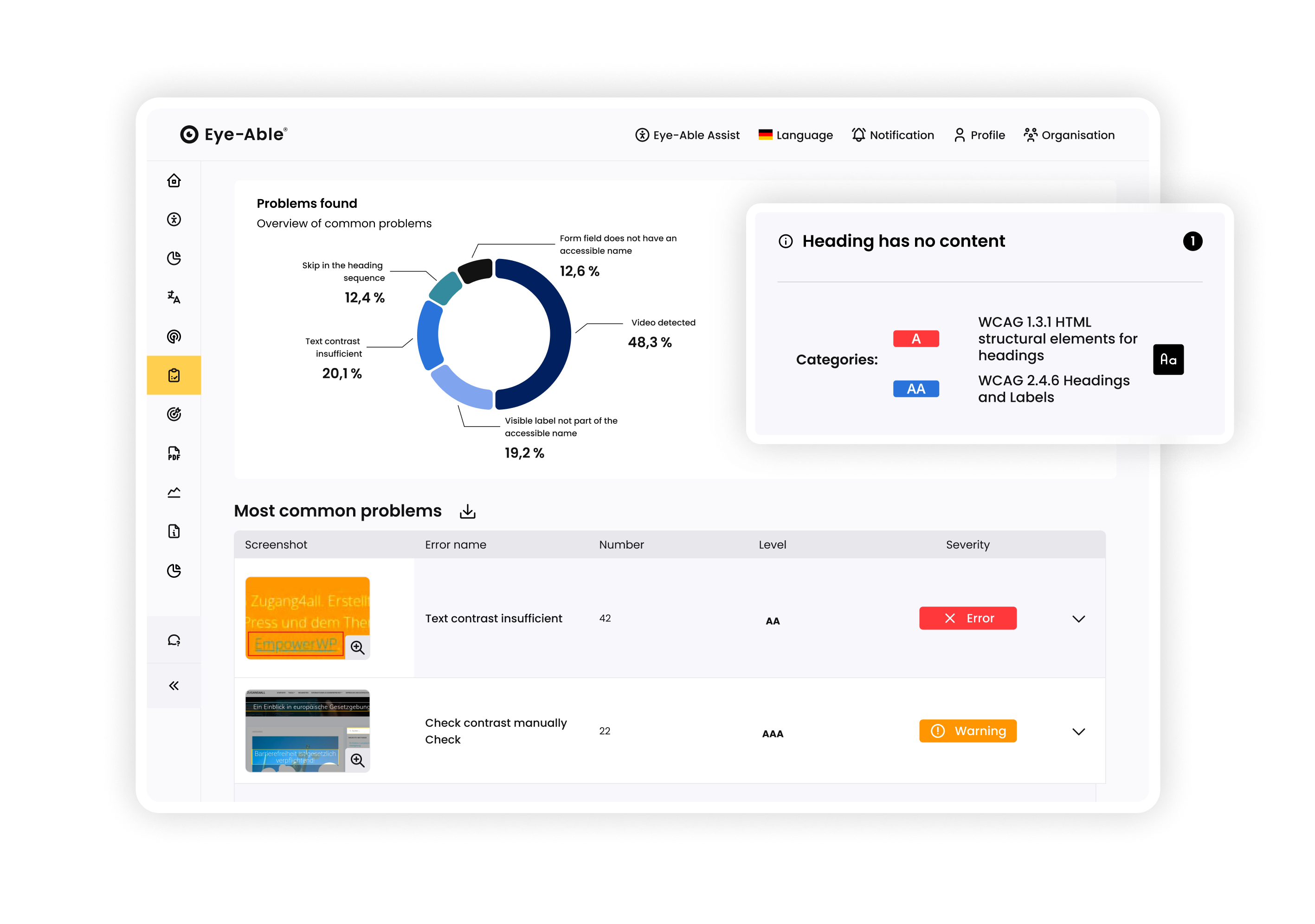
Once changes have been implemented, check whether the barriers have genuinely been resolved.
A technical fix does not automatically mean that a digital service is accessible in practice.
Regression testing is particularly useful for complex functionality and important customer journeys. Automated testing can confirm many technical improvements, while manual testing can uncover problems that tools struggle or are unable to detect.
Testing with people with disabilities adds another valuable perspective. It can show whether a process is genuinely understandable and operable and whether it works with different assistive technologies.
The aim is to make sure that a change made in the code translates into a meaningful improvement for the people using your service.
EAA compliance is not only about identifying and removing accessibility barriers. Organisations should also be able to demonstrate how they are meeting the applicable accessibility requirements.
Document:
which digital services and user journeys have been assessed
which accessibility barriers were identified
which corrective measures were taken
the results of subsequent tests
responsibilities within your organisation
your processes for ongoing accessibility monitoring
This documentation provides an internal record of your progress and makes it easier to respond if a national market surveillance or enforcement authority requests information.
For services covered by the EAA, the Directive also requires providers to make information available on how the service meets the relevant accessibility requirements and to demonstrate that their service delivery and monitoring processes support continued compliance.
In other words, documentation should not be treated as an afterthought. It is part of building a sustainable EAA compliance process.
If your service falls within the scope of the EAA, you also need to provide information explaining how it meets the relevant accessibility requirements.
Under Annex V of the EAA, this information should include, where applicable:
a general description of the service in accessible formats
the descriptions and explanations needed to understand how the service operates
a description of how the relevant accessibility requirements are met
The Directive states that this information should be included in the general terms and conditions or an equivalent document. The precise implementation and terminology can differ between member states.
Depending on the country and applicable national legislation, organisations may therefore provide this information through an accessibility statement or a comparable accessibility information page.
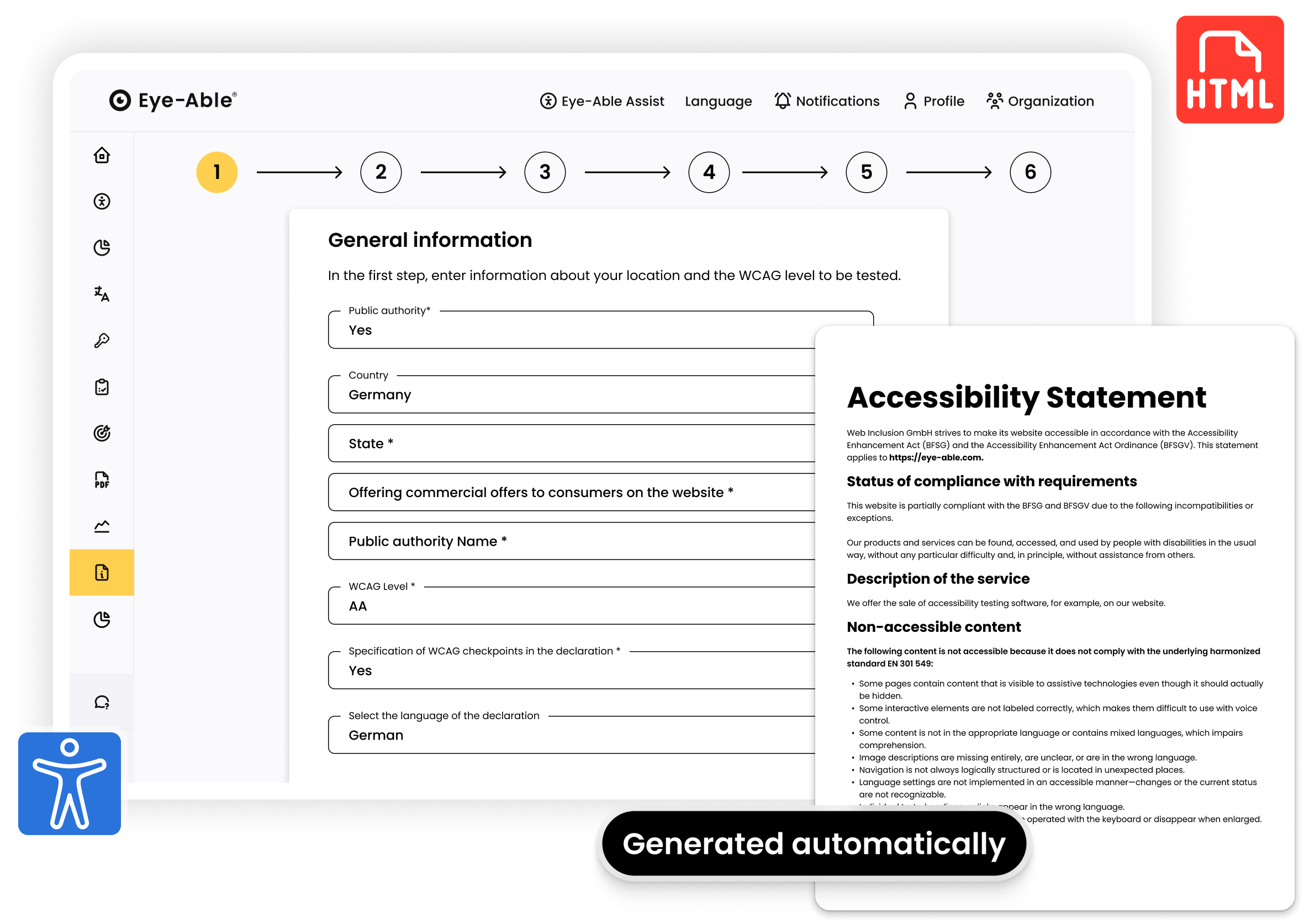
One important distinction: publishing accessibility information is not the same as simply declaring that your website is “fully accessible”. The purpose is to communicate transparently how your service addresses the applicable requirements.
Passing an accessibility assessment and fixing existing problems does not mean the work is finished.
Websites and digital services change constantly. New content is published, components are updated, features are added and entire customer journeys are redesigned.
Every one of these changes can introduce new accessibility barriers.
Regular automated monitoring can help identify technical problems at an early stage. Larger changes and important customer journeys should also be reviewed manually.
The EAA specifically expects service providers to ensure that their service delivery and monitoring processes support continued compliance with the applicable requirements.
Long-term EAA compliance therefore means treating accessibility as an ongoing responsibility rather than a one-off project.
Embed it into:
content creation
design
development
quality assurance
procurement
release processes
That way, accessibility becomes part of how your organisation works rather than something you have to fix shortly before the next audit.
Making a website EAA-compliant involves much more than fixing individual accessibility issues.
You need to look at your digital services as a whole – from defining the right scope and assessing accessibility to remediation, documentation and continuous monitoring.
Organisations that embed accessibility into their content, design, development and quality assurance processes are in a much stronger position to maintain EAA compliance over time.
At the same time, they create digital services that are easier and more convenient for more people to use.
Want to know where you stand today? With Eye-Able, you can assess your digital services, prioritise accessibility barriers and monitor your progress continuously.
Krijg een eerste overzicht van de toegankelijkheidsstatus van uw website – geheel vrijblijvend en zonder dat u voorafgaande expertise nodig hebt.
Veelgestelde vragen
Dat hangt af van de producten en diensten die u aanbiedt.
De EAA (Evidence Accessibility Act) omvat een selectie van producten en diensten voor consumenten, waaronder e-commerce, consumentenbankieren, elektronische communicatie, e-books en bepaalde vormen van personenvervoer. Een website of app die onderdeel uitmaakt van een dienst die onder de wet valt, moet daarom mogelijk voldoen aan de relevante toegankelijkheidsvereisten.
Er bestaan ook uitzonderingen, waaronder een uitzondering op grond van de richtlijn voor micro-ondernemingen die diensten verlenen. Uw precieze verplichtingen dienen daarom altijd te worden beoordeeld in de context van de relevante nationale wetgeving.
De EU-lidstaten passen de maatregelen ter uitvoering van de Europese Toegankelijkheidsverordening al sinds toe. 28 juni 2025 .
Er zijn beperkte overgangsregelingen. Zo voorziet de richtlijn in een overgangsperiode die eindigt op 28 juni 2030 in bepaalde gevallen met betrekking tot producten die al rechtmatig werden gebruikt door dienstverleners voordat de EAA van toepassing werd. Dienstencontracten die vóór 28 juni 2025 zijn afgesloten, kunnen ook ongewijzigd van kracht blijven tot hun vervaldatum, maar niet langer dan vijf jaar na die datum.
The more useful question is whether the parts of your website or digital service that fall within the scope of the EAA meet the applicable accessibility requirements.
Accessibility cannot reliably be reduced to a single percentage or automated accessibility score. Automated tools can identify many issues, but they cannot determine whether every interaction and customer journey works for people using assistive technologies.
The EAA also contains defined exemptions and exceptions, including cases involving a fundamental alteration or disproportionate burden.
This is why a combination of technical standards, automated testing, expert manual testing and real-world user testing provides a much stronger basis for EAA compliance than a single score.
If you want to learn more about how much accessibility is legally required, we recommend our blog article "Which level of accessibility is required for my website?"
De handhaving vindt plaats op nationaal niveau.
Afhankelijk van de lidstaat en de aard van de overtreding kunnen de autoriteiten klachten onderzoeken, informatie opvragen, corrigerende maatregelen eisen, een product of dienst beperken of sancties opleggen op grond van nationaal recht. De hoogte en vorm van de sancties verschillen daarom binnen de EU.
Nee.
Websites en digitale diensten evolueren voortdurend. Nieuwe content, software-updates, ontwerpwijzigingen en integraties met externe partijen kunnen toegankelijkheidsbarrières introduceren, zelfs nadat een organisatie een uitgebreid toegankelijkheidsproject heeft afgerond.
Continue monitoring, gecombineerd met handmatige tests na belangrijke wijzigingen, zorgt ervoor dat toegankelijkheid onderdeel wordt van de doorlopende kwaliteitsborging in plaats van een eenmalige oefening.
Toegankelijkheidstesten helpen u bij het identificeren van obstakels in uw website, app of digitale dienst.
Documentatie biedt bewijs van wat u hebt getest, wat u hebt gevonden, hoe problemen zijn aangepakt en hoe uw organisatie van plan is de toegankelijkheid op lange termijn te waarborgen.
Voor de gedekte diensten vereist de EAA ook informatie over hoe de dienst voldoet aan de toepasselijke toegankelijkheidsvereisten en bewijs dat het proces voor dienstverlening en monitoring voortdurende naleving ondersteunt.
Een overlay maakt een website niet vanzelf toegankelijk
Lees verhaal:no_upscale())
Digitale toegankelijkheid en SEO: waarom ook Google van deze websites houdt
Lees verhaal:no_upscale():format(png))
"Digitale toegankelijkheid is nu geen prioriteit" - en dat kost je elke dag omzet
Lees verhaal:no_upscale():format(png))
Toegankelijkheid iPhone: zo haal je alles uit de toegankelijkheidsinstellingen
Lees verhaal:no_upscale():format(png))
Mobiele toegankelijkheid: ben jij er klaar voor?
Lees verhaal
AI accessibility: Hoe organisaties inclusieve digitale ervaringen maken
Lees verhaal:no_upscale():format(png))
Eye-Able als alternatief: wat organisaties écht nodig hebben
Lees verhaal:no_upscale())
Hoe kom ik aan een toegankelijkheidsverklaring voor de EAA?
Lees verhaal:no_upscale())
Alt-tekst: zo maak je afbeeldingen toegankelijk voor iedereen
Lees verhaal:no_upscale())
Hoe AI een handje helpt bij de Wet Digitale Toegankelijkheid
Lees verhaal:no_upscale())
Veelgemaakte fouten Wet Digitale Toegankelijkheid (EAA)
Lees verhaal:no_upscale())
De Wet Digitale Toegankelijkheid (EAA) voor het MKB: Zo krijg je je medewerkers mee!
Lees verhaalNeem contact met ons op en we helpen u graag verder.
:no_upscale():format(png))
:no_upscale():format(png))